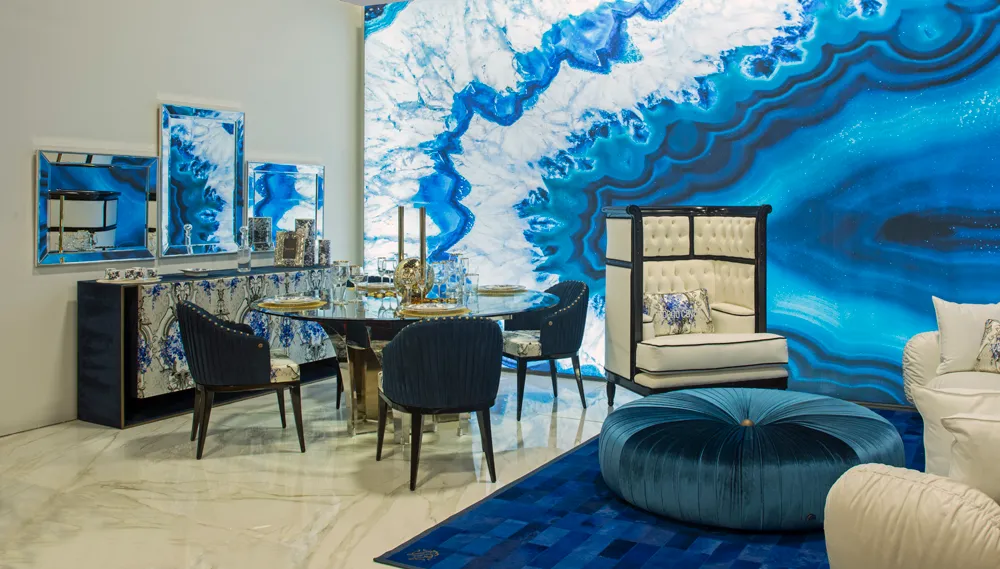
Walk into any high-end residential project right now, whether it is a waterfront estate in Palm Beach, a penthouse in Toronto, or a mountain house in Aspen, and look at the walls. Not the art on them. The walls themselves.
Something has shifted. For roughly twenty years, the safe answer for a wall was paint, and wallpaper carried the faint stigma of a decade nobody wanted to revisit. That era has ended decisively. Wallcoverings have become one of the fastest-growing categories in luxury residential design, and the reason is not nostalgia. It is that designers ran out of ways to create depth with paint.
Silk. Grasscloth. Wood veneer. Hand-painted chinoiserie. Custom digital murals scaled to one specific wall in one specific house. These materials do something paint structurally cannot: they hold light differently across a surface, they introduce texture the eye reads before the brain names it, and they make a room feel composed rather than decorated.
But here is what has not kept pace with the material. The trade.
The material changed. The trade did not.
The gap between what luxury wallcoverings require and what the general installation market can deliver has become one of the quiet risks in high-end residential construction.
A printed paper from a big box retailer is forgiving. It comes in multiple rolls from a repeatable print run, the pattern repeat hides small errors, and if a panel goes wrong you order another. Nothing about that describes the materials now specified in luxury interiors.
A hand-painted de Gournay panel is exactly that: painted by hand, as a set, for your room. A Gracie scenic is produced in a sequence where panel three only works beside panel two. Fine silks show every fingerprint, every adhesive migration, every fractional misalignment at the seam, and they cannot be cleaned. Grasscloth has natural variation that has to be intentionally sequenced across a wall or it reads as a defect rather than a texture.
These materials can carry five figures for a single room. They arrive on a schedule that does not accommodate a reorder. And they punish a quarter inch.
Katie Hunt has built her business in exactly that gap.
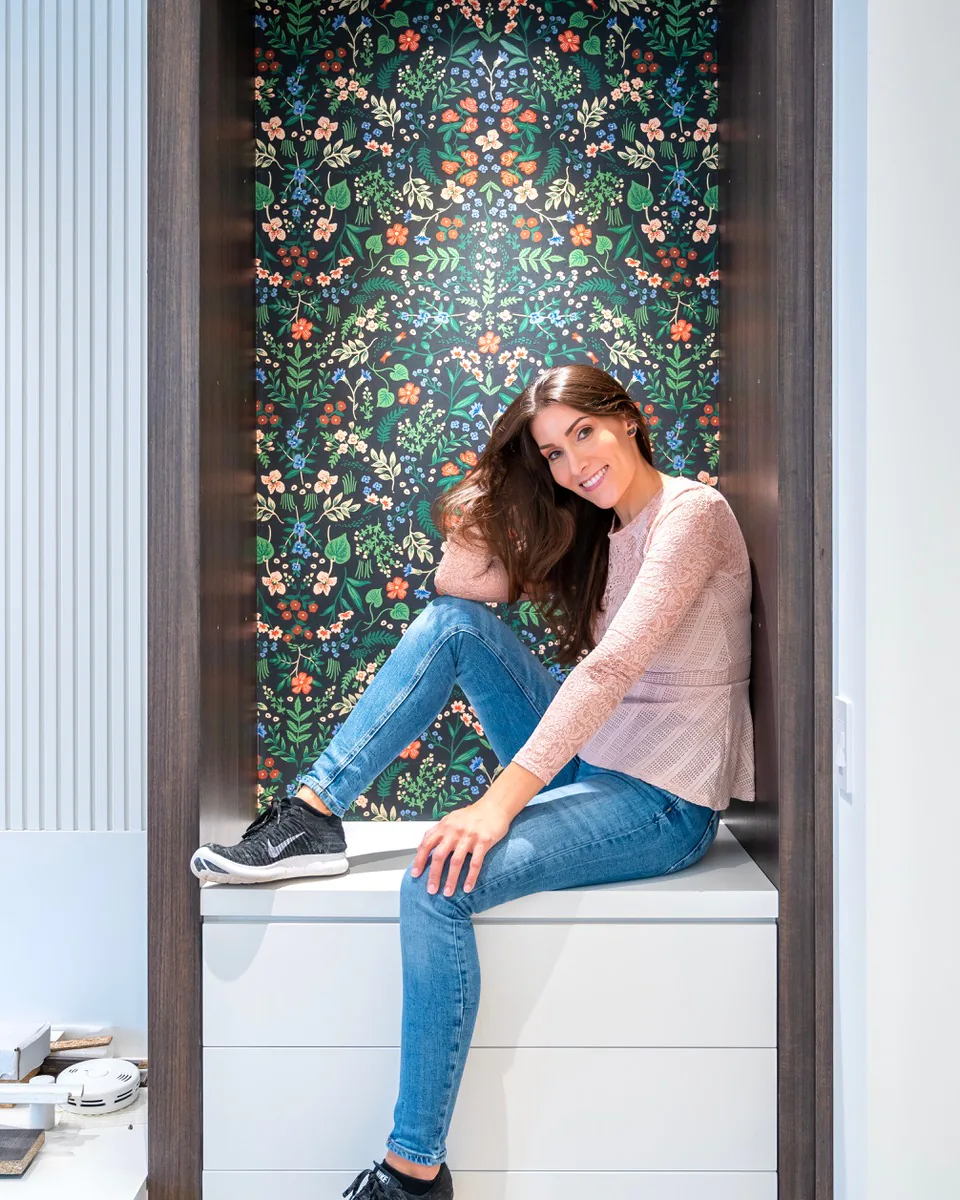
As Founder and Lead Installer of Katie’s Wallpaper Installation, Hunt works with leading interior designers, luxury home builders, celebrities, and high-net-worth homeowners across the United States and Canada, traveling to projects wherever the material and the client require it. Her home market spans Palm Beach, Delray Beach, Boca Raton, Fort Lauderdale, and Miami, but a significant share of her work happens outside it, which is a direct consequence of how few teams operate at this level. Her work has appeared on HGTV, including Property Brothers and Holmes on Homes, as well as Disney+, Hulu, and HBO Max. Her team of ten senior installers each bring 15 to 20 plus years of specialized experience.
That reach is itself the clearest evidence of the gap. When a designer in another state or another country flies in a specialist rather than hiring locally, it is because the material on order does not permit a learning curve.
Ask her what has already gone wrong on the jobs she gets called in to rescue, and the answer is never the paper.
“Wallpaper adhesion is only as strong as the surface underneath it.”
THE REQUIREMENTS
Five things a luxury installation requires
01 The room gets mapped before anything gets cut
No wall in a residence is truly plumb, no ceiling is truly level, and no room is truly square. On a forgiving material, that does not matter much. On a scenic mural or a silk with a strong vertical, it determines whether the finished wall reads as intentional or as slightly wrong in a way nobody can articulate.
Hunt’s team maps entire rooms with 3D lasers before installation begins, establishing optimal panel placement and symmetry against the actual geometry of the space rather than the geometry the plans assumed. Where the eye will land, where the seams fall relative to sightlines and architectural features, how a mural centers on a wall that is three-quarters of an inch out of square across its height. Those decisions get made deliberately, in advance, on paper.
The alternative is discovering the problem when the panel is already wet and on the wall.
02 Substrate preparation is most of the job
Luxury wallcoverings telegraph everything underneath them. A patched drywall seam, a texture variation, a spot of residual adhesive, a wall primed with the wrong product for the material going over it. On a silk or a metallic, those flaws surface under raking light and cannot be corrected without removing the material.
This is the single most common failure Hunt encounters on projects that have gone wrong before she is called, and her answer to it is unglamorous and specific.
IN HER WORDS
Prep work is one of the most important aspects of any project, and wallpaper is no exception. In order for wallpaper to properly adhere to the surface, it is important that the walls are smooth and have a high-quality wallpaper primer applied.
The best way to think about it is that wallpaper adhesion is only as strong as the surface underneath it, which is why having the best possible bond is so important. I recommend ROMAN PRO-977 Wallpaper Primer, which is specifically designed for professional wallpaper installation and helps create a strong, long-lasting foundation for the wallpaper.
The preparation stage on a specialist installation frequently takes longer than the hang itself. When a bid comes in dramatically under the others, this is almost always where the difference lives.
03 Seam work is where craft becomes visible
Factory edges are not always the most precise edges available. Hunt’s team uses proprietary trimming techniques that produce cleaner results than factory seams, which is the kind of detail that sounds like marketing language until you stand in front of a grasscloth wall where every seam disappears and compare it to one where they do not.
Seams are the single most common failure point in wallcovering installation, and they are permanent. A designer can live with a lot of things. A visible seam running down the focal wall of a primary bedroom is not one of them.
04 Sequencing and handling of irreplaceable goods
Specialist installers treat a delivery of hand-painted panels the way an art handler treats a canvas: inspection on arrival, controlled storage conditions, panel-by-panel verification against the sequence, acclimation before installation. Materials that have traveled from a studio in England or China do not respond well to going straight from a hot truck to a wall in August.
Ask any designer who has had a project delayed six weeks waiting on a replacement panel. The handling protocol is not overhead. It is insurance.
05 Partnership with the designer, not just execution
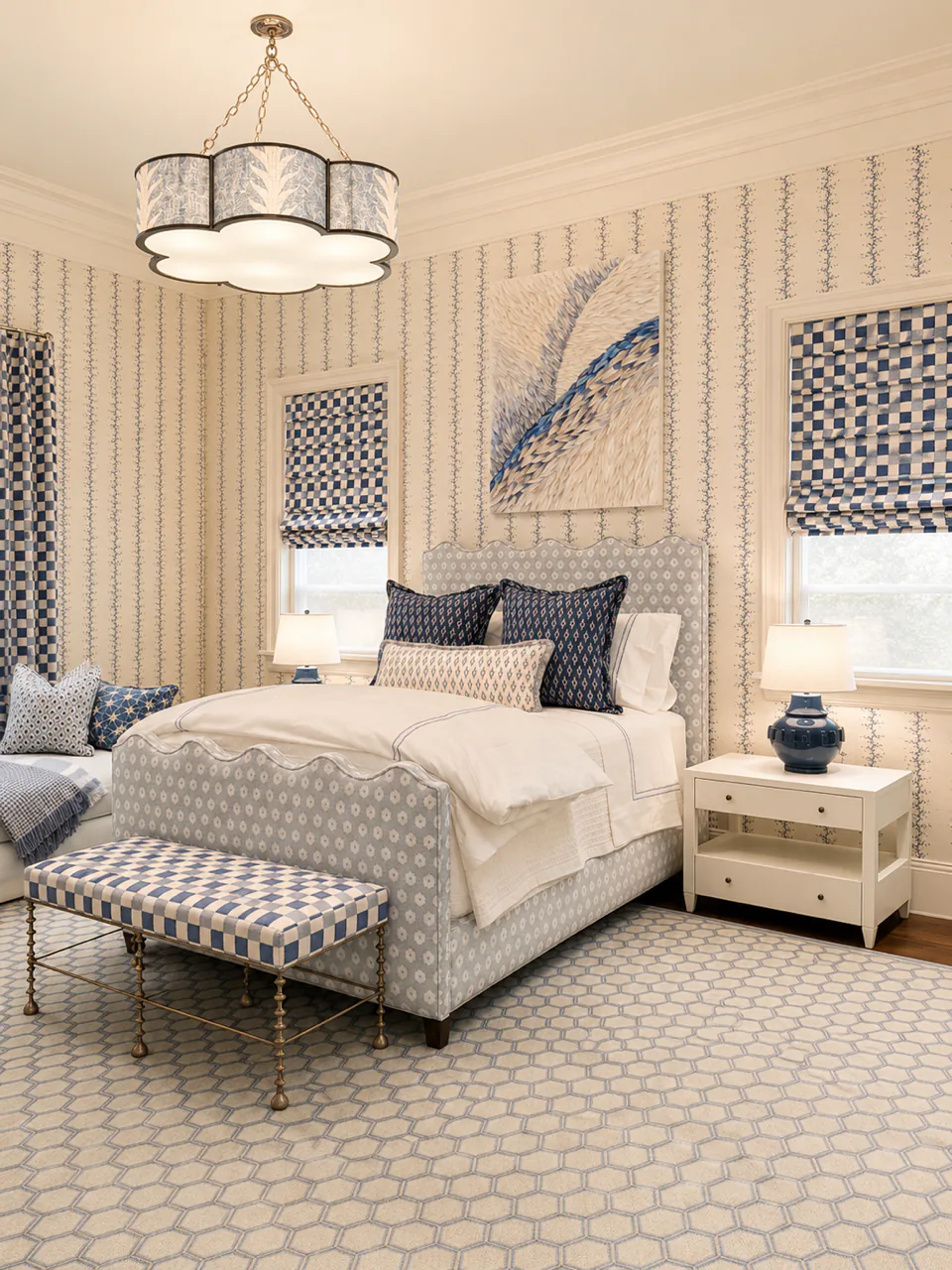
The best installers function as a technical resource during specification, not just a pair of hands after it. Which material can survive a bathroom with a steam shower. Whether a particular mural can be adapted to an unusual wall height without destroying the composition. What the realistic lead time is, and how it maps against the install calendar.
Hunt is known within the design community for exactly this: helping designers bring a vision to life rather than telling them what cannot be done after the material has already been ordered. Asked what she wishes designers had raised with her earlier, she does not name a brand. She names the room.
“Selecting wallpaper is fun and can be an exciting part of any project. However, finding the right type of wallpaper for the application is also very important.”
SPECIFICATION
Specifying by room, in her words
Three rooms where the wrong choice is not a matter of taste but of physics.
Ceilings. Hunt generally recommends a more matte finish overhead. Light reflects at a sharp angle on a ceiling, and a shiny or reflective wallcovering will highlight imperfections in the surface rather than conceal them.
Bathrooms. Her recommendation is a non-woven wallpaper. The technology is newer; it is breathable, and it does not expand or contract with humidity, which produces higher-quality seams and better long-term performance in a room that punishes both.
Dining rooms and living rooms. For a luxury finish in the rooms that carry a house, she points to Phillip Jeffries for silk and natural wallcoverings, and to hand-painted designs from de Gournay, Gracie, or Aqualille, which is based in Florida.
IN HER WORDS
For example, if you are selecting wallpaper for a ceiling, we generally recommend a more matte finish. Light reflects at a sharp angle on ceilings, and a shiny or reflective wallpaper may highlight imperfections in the surface.
For bathrooms, I recommend a non-woven wallpaper. This newer wallpaper technology is breathable and does not expand or contract with humidity, helping to provide higher-quality seams and long-term performance.
If you are looking for a luxury finish in spaces such as a dining room or living room, I highly recommend Phillip Jeffries for silk and natural wallcoverings, or hand-painted designs from de Gournay, Gracie, or Aqualille, which is based in Florida.
It is worth noticing what that answer is not. It is not a list of favorites. Every recommendation is indexed to a condition in the room: the angle light strikes a ceiling, the moisture load in a bathroom, the level of finish a formal room can carry. That is what a specification conversation sounds like when the person having it will also be the one installing the result.
ON SET
What television taught her about the wall behind the reveal
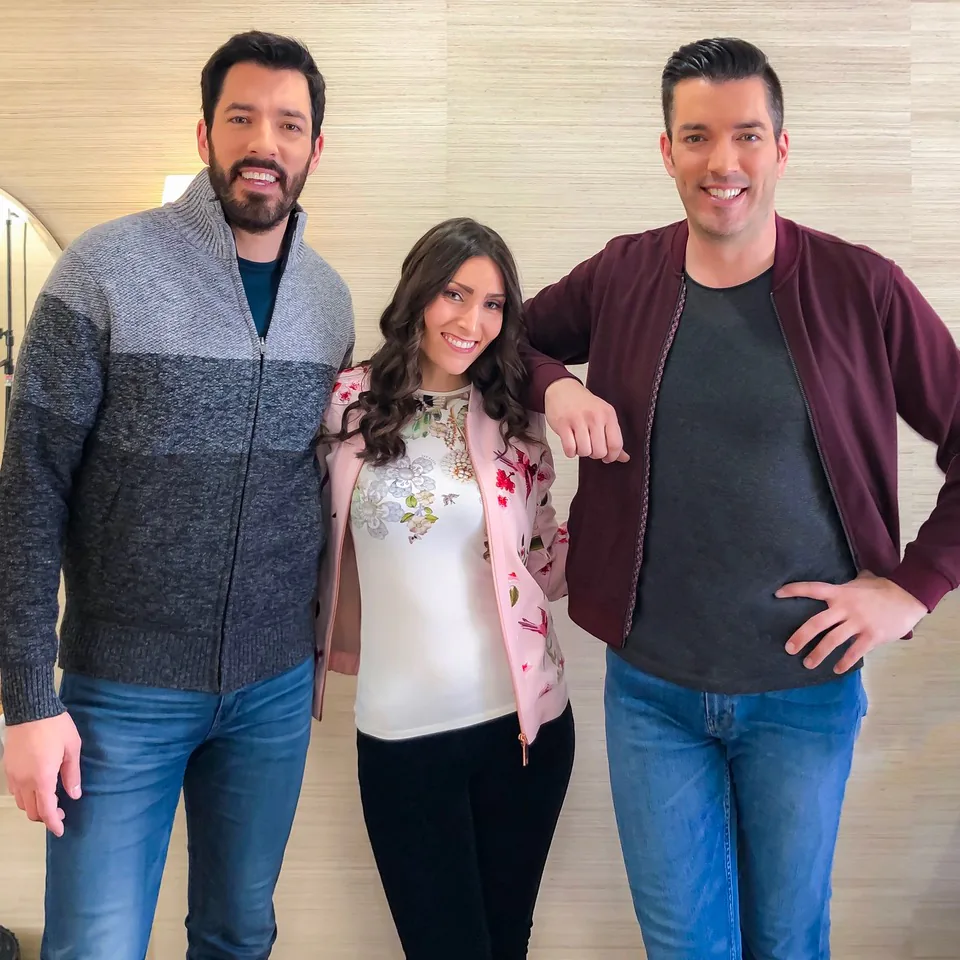
Hunt’s work has appeared on HGTV, including Property Brothers and Holmes on Homes, along with productions for Disney+, Hulu, and HBO Max. On a bio, that reads as a credential. Ask her about it, and the first thing she describes is not the reveal. It is everything that had to happen before the cameras were switched on.
“While viewers see the finished reveal, there is an enormous amount of planning, coordination, and craftsmanship that takes place before the cameras start rolling.”
The structural difference between a television project and a private commission is the clock, and specifically who owns it. On a luxury installation, the material sets the pace. On a production, the schedule belongs to somebody else, and every trade in the house is working inside it at once.
IN HER WORDS
Working on HGTV shows such as Property Brothers and Holmes on Homes was an incredible experience and provided a unique behind-the-scenes look at the renovation industry.
One of the biggest differences between television projects and traditional installations is the timeline. Television productions often operate on very tight schedules, which requires every trade to work efficiently while still delivering exceptional quality.
That constraint sits in direct tension with everything in requirement 02. Preparation is the stage that takes the longest and shows the least, and it is also the stage that cannot be compressed without consequences that surface months later. Learning where a schedule can absorb pressure, and where it cannot, is the discipline television teaches an installer faster than anything else.
What the work produced beyond the footage was a set of relationships inside the industry.
IN HER WORDS
One of the most rewarding parts of working in television was the relationships built along the way. I was fortunate to make some amazing friends in the industry, both on and off camera. Over the years, I developed friendships with Jonathan and Drew Scott and had the opportunity to work alongside talented designers, contractors, and production teams who are passionate about creating beautiful spaces.
I was also fortunate to install wallpaper in both Jonathan Scott and Zooey Deschanel’s home, as well as Drew Scott and Linda Phan’s home. These were memorable projects and a reminder of how wallpaper can play a significant role in creating unique, personalized spaces.
There is a broader point buried in the television work, and it explains something about the category’s current momentum. For most of its history, wallcovering was a trade finished before the client came home. Renovation television did something no trade publication managed to do: it put the material on screen at the exact moment a room was revealed, in front of an audience of millions who were not thinking about walls at all until that second.
“Whether it is a subtle textured wallcovering, a dramatic mural, or a luxurious hand-painted design, wallpaper can completely transform a space and create a memorable final reveal.”
That is a large part of why her sessions in Fort Lauderdale are built around a live installation rather than a slide deck. The argument this article makes in text is considerably more persuasive when you watch a panel go up.
CASE STUDY
Embroidered wool, stretched flat, in Jupiter
Asked to name the most difficult installation she has completed, Hunt does not describe a scenic mural or a two-story stairwell. She describes a material that was never manufactured to go on a wall at all.
IN HER WORDS
One of the more complex installations involved applying a de Gournay fabric upholstery with embroidery on wool as a wallcovering.
The result was stunning; however, it required very advanced installation techniques, as the embroidery was raised and the fabric had to be carefully stretched to achieve a smooth application.
KATIE HUNT, ON THE HARDEST WALL SHE HAS DONE
Consider what that involves. An upholstery-weight wool carries dimensional embroidery, which means the surface is not flat and cannot be made flat by pressure. The material has to be brought into tension across the plane of the wall, evenly, in every direction at once, without distorting the embroidered pattern and without leaving a single soft spot that will read as a ripple under a lamp. There is no adhesive strategy that rescues a mistake here, and there is no second piece of the goods.
It is the clearest possible illustration of the argument this article opened with. The material arrived from a de Gournay atelier. The design decision belonged to the interior designer. Whether any of it worked came down to technique at the wall.
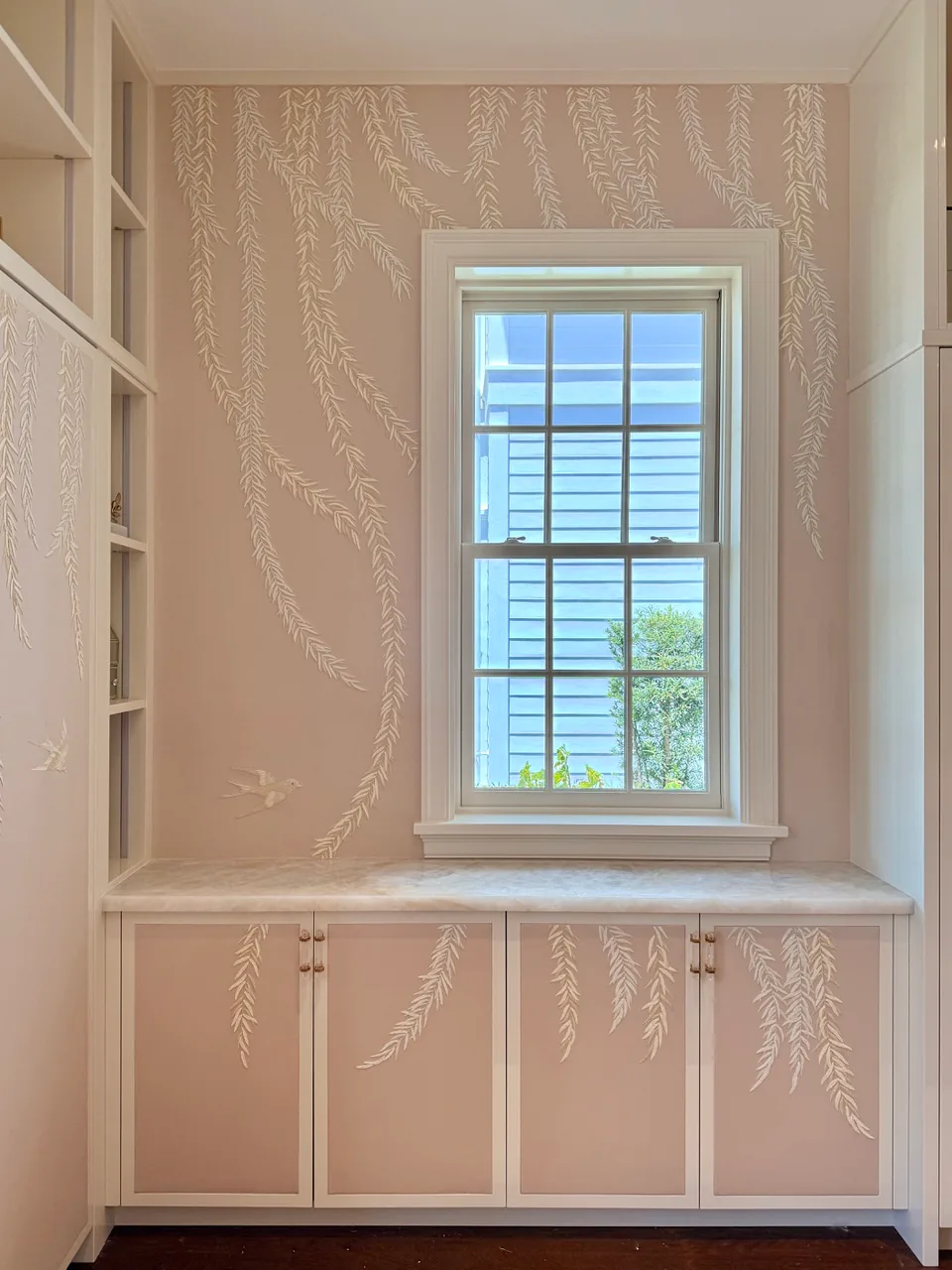
de Gournay embroidered wool upholstery installed as wallcovering, Jupiter, Florida
Installation: Katie’s Wallpaper Installation · Interior design: Taylor Interior Design
DILIGENCE
What designers should ask before hiring an installer
A short diligence list worth keeping.
- Have you installed this specific brand and material before? Experience with printed papers does not transfer to silk, veneer, or hand-painted goods.
- What primer do you use, and is preparation included in the bid? A specialist will name a product. If the answer is vague, the number is not comparable to other bids.
- What is your process for mapping and panel placement? Look for a real methodology, not “we eyeball it and start from the corner.”
- How do you trim and treat seams? A specialist will have a specific answer and will want to show you work.
- Are you insured for the value of the material? On a five-figure scenic, this is not a formality.
- Who is actually on my job? Some firms sell you the principal and send a subcontractor. Ask directly.
- Can I see completed work in person, not just photographs? Photography hides seams. Standing in the room does not.
What homeowners should know
- Wallcoverings are not only for oceanfront estates. The category spans traditional papers, custom digital murals, luxury silks, textiles, hand-painted designs, and specialty materials, with solutions across virtually every design style and budget. A powder room is one of the highest-impact, lowest-cost places to start.
- Lead times are longer than you expect. Hand-painted and custom goods can run months from order to delivery. If wallcoverings are part of a renovation, they need to be specified early, not chosen at the finish stage.
- Where you install matters as much as what you install. Focal walls, entries, dining rooms, powder rooms, ceilings, and the back walls of built-ins deliver disproportionate return. Wrapping every wall in a large room is rarely the strongest use of the budget.
- The installation is not the place to economize. The material is the expensive part, and a poor installation destroys it permanently. Spending less on the paper and more on the installer is almost always the better trade.
The houses behind the names
Phillip Jeffries. Natural textures, grasscloths, and silks that have become a signature of contemporary luxury interiors, and Hunt’s first recommendation for a natural wallcovering in a formal room.
de Gournay. Hand-painted wallpapers, panels, and fabrics produced in the tradition of the finest historic chinoiserie.
Gracie. Hand-painted scenic wallpapers with a legacy stretching back more than a century.
Aqualille. Hand-painted and custom wallcoverings, based in Florida, which makes it a meaningful option for regional projects working to a tighter delivery window.
LOOKING AHEAD
Where the category is heading
Three developments showing up consistently across high-end projects in both the United States and Canada.
OVERHEAD
Ceilings. The fifth wall has become the move designers use when a client wants something unexpected, and the walls are already committed. Grasscloth and hand-painted treatments overhead read as extraordinarily considered, provided the finish is matte enough to survive the angle of the light.
ACCESS
Custom digital at true luxury quality. Printing has advanced far enough that bespoke murals now compete with traditional hand-painted work on visual impact at a materially different price point, which is opening the category to projects that could not previously access it.
DIRECTION
Texture over pattern. The strongest work right now is not loud. It is silk, veneer, embroidery, and woven material chosen for how it behaves under light rather than for a print. That direction has staying power in a way that heavy pattern historically has not.
SEE THE CRAFT IN PERSON
Katie Hunt, live on the Home Design Stage
Fort Lauderdale Home Design and Remodeling Show, September 4 through 7 at the Broward County Convention Center. Both sessions feature a live luxury wallpaper installation on stage.
FRIDAY, SEPTEMBER 4 · 3:00 PM
Wallpaper is the New Luxury: The Finishing Touch That Takes Design to the Next Level. For design and building professionals.
SATURDAY, SEPTEMBER 5 · 4:00 PM
Let’s Explore Wallpaper: Take Your Home to the Next Level. For homeowners.
Watching a specialist handle a panel in real time, with commentary, communicates something no article can.